
Welby Elementary School Student Wellness and Prevention Plan 2026-2027
At Welby, we believe that academic excellence and student well-being go hand-in-hand to help every child reach their full potential. By practicing our Big Four—Respect, Responsibility, Safety, and Kindness—we create a rigorous environment where students have the confidence to take risks, learn from mistakes, and tackle hard things. Through thoughtful, collaborative, and reflective practices, we partner with our families to ensure every student is both challenged and supported on their journey to success.
Prevention Plan Overview
The prevention plan below for Welby Elementary School has been created following Jordan District guidelines, which can be reviewed at wellness.jordandistrict.org.
Research shows that addressing behavior and wellness concerns before they occur is much more effective than trying to stop them after they start. Proactive efforts are our primary prevention strategies. These strategies focus on the root causes, like enhancing protective factors and decreasing risk factors, strengthen well-being and help students build resilience to thrive. They act as buffers against risk and promote resilience, healthy development, and positive outcomes. Risk factors are conditions that increase the likelihood of academic, behavioral, or mental health difficulties. Our school supports student development of Utah State Board of Education’s five protective factors represented by the graphic below; here is more information about these protective factors.
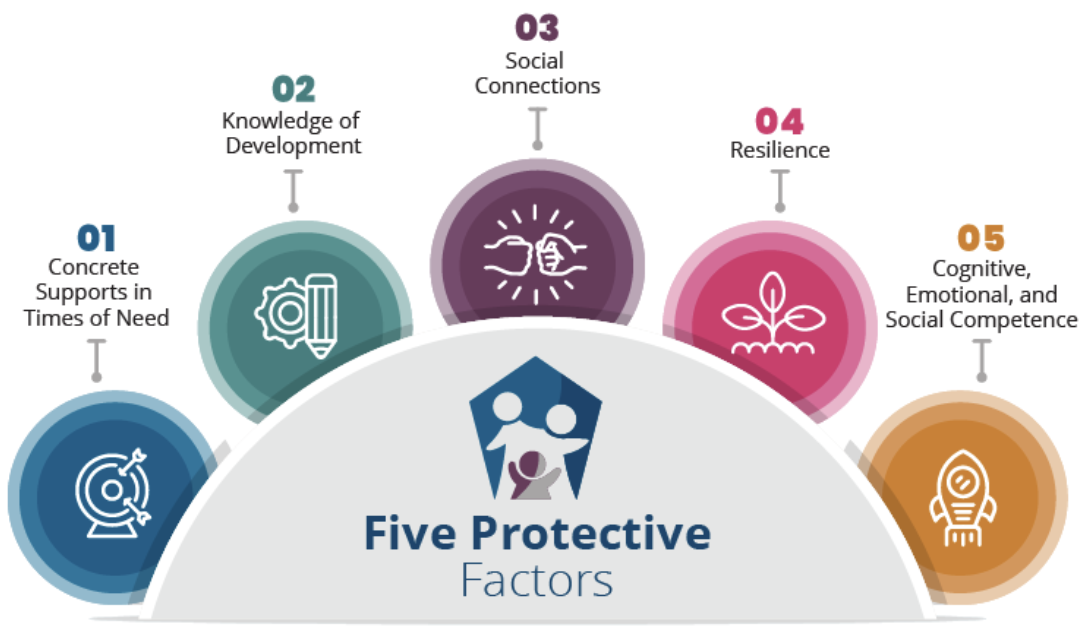
Our school supports student wellness by prioritizing primary prevention practices that are centered on building protective factors and promoting positive, intentional social, emotional, academic, and behavioral development for all students. This prevention plan includes universal strategies (for all students) as well as targeted strategies (for small groups or a few students) for each section below.
Student Engagement and Attendance
Our school believes that attendance directly impacts academic achievement, social development, and future success. Attendance also reflects a student’s sense of belonging. Some of the efforts our school prioritizes to encourage student engagement and promote attendance are listed below:
- Panorama early warning system to identify students who may be at risk of disengagement or absenteeism, which allows us to proactively support students in feeling connected and engaged at school;
- Our school staff cares about our students and is committed to getting to know them to help them feel a sense of belonging;
- Creates frequent opportunities for students to connect with each other, build friendships, and feel a sense of belonging with their peers during class, at recess and lunch, and throughout their day;
- Staff monitors attendance using the District dashboard and notifies families of absences;
- Our school staff regularly participate in coaching cycles and professional development to refine teacher practices and help support increased student engagement;
- Our school employs specific staff to support student attendance, including check-ins, home contacts, and additional support as needed;
- We use a Positive Behavior Intervention System based on the Jordan School District Portrait of a Graduate Characteristics. Students work to earn individual and class rewards using this system.
- We reinforce on-time attendance with our “No Tardy Smartie” reward system for students who are present and ready to learn at the beginning of the day;
- School staff and Parent-Teacher Association (PTA) work together to actively plan and host a variety of fun school events and family activities;
- Our school recognizes student achievement related to the Jordan School District Portrait of a Graduate characteristics through a monthly award ceremony and parade;
- Our school holds a Culture Fair where teachers, students, and families come together to share and celebrate the diverse cultures represented at Welby and within our broader community that are learned and shared throughout the year.
Social, Emotional, and Behavioral Well-Being
Our school prioritizes prevention by offering support and services to our students and their families. Some of our everyday efforts, including the systems and strategies for supporting our students, are listed below:
- We teach and model our “Big Four” expectations—Respect, Responsibility, Safety, and Kindness—throughout all school settings;
- Staff regularly provide lessons and opportunities for students to practice essential skills based on the characteristics of the Jordan School District Portrait of a Graduate. Welby Wildcats are:
- Curious Thinkers
- Empathic Communicators
- Engages Citizens
- Responsible Teammates
- Resilient Life Long Learners
- Creative Problem Solvers
- We offer access to counseling, mental health resources, and wellness checks for students who need additional support;
- Our school uses data to identify students who may need extra help to provide targeted interventions and support;
- We partner with families and the PTA to host events that build a sense of belonging and strengthen our supportive community;
- Collaboration among staff ensures a consistent, proactive approach to supporting student well-being and addressing behavioral concerns. Our teachers meet in weekly Professional Learning Community (PLC) collaboration and intervention teams to ensure every student's academic and emotional needs are being met;
- Our school has a Recess Specialist that fosters a community of inclusion by inviting all to participate in learning and playing new and exciting recess activities;
- Our students have the opportunity to attend Music, Art, STEM, PE, and Library weekly to participate in structured learning using Utah State Core Standards;
- Our school has a Bridge Team that meets monthly to focus on student behaviors, attendance data, and other school priorities as needed;
- We help provide access to District mental health and support resources through Student Services, which includes the Jordan Family Education Center and Mental Health Access Program;
- We provide access to academic support with District departments to support the success of every student;
- Our school’s mental health and student support providers (school counselors, school psychologists, clinical support, etc.) are trained and supported by District administration to follow current best practices in prevention and intervention efforts;
- We intervene with early warning, content monitoring, and anonymous reporting tools with support from District specialists to identify and support students who may be at risk;
- Our school provides access to parent and family resources including a District partnership with the Cook Center for Human Connection’s Parent Mental Health Series platform which is shared with parents monthly through Parent Square and District web content;
- Our school communicates upcoming events and reminders through a weekly newsletter that is sent out via ParentSquare.
Bullying Prevention
Bullying is unwanted, aggressive behavior that involves a real or perceived power imbalance. The behavior is repeated, or has the potential to be repeated, over time.
Bullying is recognized and defined by three primary characteristics. It is aggressive behavior that is usually repeated over time, occurs in a relationship where there is a power imbalance, intends to cause harm or distress and/or has a serious harmful or distressing effect on the target. Please visit the Jordan School District Health and Wellness website for additional information.
- Our school displays Stop-Walk-Talk rules and procedures, featuring student photos demonstrating each step, to teach students how to respond to unwanted behavior: tell the person to stop, walk away if it continues, and talk to an adult if they need further help;
- Our staff proactively addresses and prevents bullying by teaching essential interpersonal skills, recognizing and reinforcing positive behaviors, and using restorative practices to build understanding and repair relationships within our school community;
- Our school team proactively reviews relevant data on school climate, safety, and bullying by identifying vulnerable populations (e.g., racial and ethnic groups, LGBTQ youth, students with disabilities) and specific spaces where bullying may be likely to plan support accordingly;
- Our school’s staff receives annual training at the beginning of each school year and ongoing refreshers throughout the year on procedures for recognizing, reporting (using SafeUT, content monitoring, etc.), and responding to bullying incidents;
- All of our District’s staff participate in an annual crucial concerns training to maintain employment in the District which covers topics such as suicide, bullying, and violence prevention;
- Students involved in incidents of bullying as targets, aggressors, or witnesses receive support for their individual needs which may include suicide risk assessments, counseling and mental health services, Functional Behavior Assessment (FBA), Behavior Intervention Plan (BIP), a student wellness plan and/or parent/guardian contact—recognizing that targets, aggressors, and witnesses of bullying are more susceptible to school issues;
- Our school’s administrators have been trained on Bullying Action Planning through the District Wellness Team and continue to implement best practices in bullying intervention, with the overall goal of prevention;
- Our school prioritizes early intervention and utilizes several District supported tools to support student wellness when needed such as content monitoring on student’s school accounts to respond to concerning content, SafeUT anonymous reporting for students to express concerns, and early warning data system through Panorama;
- If bullying is reported, teachers and administration work quickly to investigate and resolve incidents, including reviewing available video footage, conducting threat assessments, interviewing involved parties, providing support, and reaching out to families.
Violence Prevention
- Our school’s administrators are trained on the Comprehensive School Threat Assessment Guidelines (C-STAG), along with other members of our school’s threat assessment team which includes our school psychologist and counselor;
- Our school has a process for timely response to school threats using Comprehensive School Threat Assessment Guidelines (C-STAG) and its decision tree. This includes contacting potential victims and their parents/guardians;
- Our school’s staff and students are aware of school procedures for recognizing and reporting (SafeUT, content monitoring etc.) threats of violence. Teachers share procedures with students at the beginning of the year and review them often;
- Students who are affected by or who make threats of violence receive interventions that proactively support students by building skills, meeting needs, and problem solving that aligns with the school’s universal strategies. Students receive support appropriate to their individual needs which may include problem-solving, interviews, suicide risk assessments, Functional Behavior Assessment (FBA), Restorative Conferencing, Mediation, a Behavior Intervention Plan (BIP), counseling and mental health services, a student wellness plan and/or parent/guardian contact;
- Our school prioritizes early intervention and utilizes several District supported tools to support student wellness when needed, including content monitoring on student’s school accounts to respond to concerning content, SafeUT anonymous reporting for students to express concerns, and early warning data system through Panorama;
- All of our District’s staff participate in an annual crucial concerns training to maintain employment in the District which covers topics such as suicide, bullying, and violence prevention;
- Our school practices additional conflict resolution skills including active listening, cool downs, reflective practices, social stories, and brainstorming.
Suicide Prevention
- Our school’s mental health providers and administrators are trained on and review District suicide risk intervention guidelines annually with support from Jordan District’s Student Services Team;
- Our school’s mental health providers and administrators regularly update staff on procedures for supporting students expressing self-harming language and behaviors;
- All of our District’s staff participate in an annual crucial concerns training to maintain employment in the District, which covers topics such as suicide, bullying, and violence prevention;
- Students identified who may be at risk of suicide receive interventions and support in partnership with their parents and guardians, appropriate to their individual needs. This may include a screening interview, parent/guardian collaboration, a safety plan, mental health recommendations/referrals (Jordan Family Education Center, Mental Health Access Program, etc.), a re-entry meeting, and regular follow-up;
- Our school prioritizes early intervention and utilizes several District supported tools to support student wellness when needed. These tools include content monitoring on student’s school accounts to respond to concerning content, SafeUT anonymous reporting for students to express concerns, and early warning data system through Panorama;
- Our teachers work regularly through professional development and coaching cycles to support the development of help-seeking and coping skills for students;
- Our school counselor introduces monthly lessons based on the Jordan School District Portrait of a Graduate Characteristics that are supported daily within the classroom environment.
Additional Strategies
- Students participate in red-ribbon-week for drug and alcohol prevention;
- 5th-grade students participate in DARE with a school resource officer (South Jordan PD);
- Many classrooms have a calm-down corner and all classrooms have strategies to help students self-regulate.
Please contact our school for any questions regarding our plans. We are here to help!